🇩🇪 Made in Germany
 English
 Magyar
 Deutsch
Frequently asked questions
The following FAQs are some common questions from our customers. If you have any further questions, please send them to info@syprin.de.
Do you need help?
If you have a problem or question that requires immediate assistance, you can click the button below to chat live with a customer service representative.
If we are unavailable, send us an email and we will get back to you within a few hours!
Is your question not there? Contact us here!
Can cleaners and additives be used together?
Never put cleaner and additive in the tank together. First, add the cleaner when the tank is no more than one-third full, fill up the tank, drive 50-60 miles, and then continue driving as normal. Add the additive the next time you fill up, then continue filling up the tank.
How do you use the Diesel Rescue Box?
Fill the large bottle of cleaner (500 ml) into a tank that is no more than one-third full—ideally empty. Fill the tank completely and drive 80-100 km to loosen dirt in the system; then use the vehicle normally until the fuel level reaches the same level. The next time you fill up, add the small bottle of additive (250 ml), then continue filling the tank.
Is a full can too much for smaller tanks?
No, for normal car tanks up to 80 l (diesel/gasoline), always use the entire can. The specification “up to 80 l” describes the maximum effective range. For motorcycles with tanks up to 15 l, 1/4 of a can is sufficient. The self-mixing product is safely dosed.
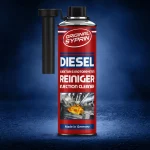
How is the diesel cleaner used?
Pour the diesel cleaner (500 ml) into a tank that is no more than one-third full—ideally empty. Fill the tank completely and drive 80–100 km immediately for best results; then continue to use the vehicle as normal.
What is the difference between a cleaner and an additive?
The cleaner removes dirt and deposits from the fuel system, such as fuel injectors. The additive maintains the engine, protects against rust, and increases performance.
Do the cleaner and additive have the same fill quantity?
No. The cleaner has 500 ml, the additive 250 ml per application.
How often is the diesel cleaner used?
Use the diesel cleaner 2-3 times a year, ideally before seasonal changes such as tire changes.
For which engines is the diesel cleaner suitable?
The diesel cleaner is suitable for all diesel engines – with or without DPF, turbo, and compatible with biodiesel.
How is the diesel additive used?
Pour the diesel additive (250 ml) into a tank that is no more than one-third full, then fill the tank completely.
Is the gasoline cleaner compatible with E10?
Yes. It is suitable for E10 gasoline and all gasoline engines in cars, motorcycles, and generators.
In what order should the Diesel Rescue Box Plus be used?
First use the system cleaner (large red bottle), then the DPF cleaner (small yellow bottle) the next time you refuel. The small red additive bottle is used the next time after that.
How often should you use the gasoline cleaner?
Use the gasoline cleaner quarterly or every 2000 km (500 ml to 80 l).
What does the Gasoline Rescue Box do?
The Gasoline Rescue Box cleans the fuel injection system, optimizes atomization, and reduces fuel consumption and exhaust emissions.
Difference between cleaner and care products in the Gasoline Rescue Box?
The cleaner removes heavy deposits, while the maintenance additive provides long-term protection for valves and cylinders.
Is the gasoline Rescue Box suitable for motorcycles?
Yes. It is suitable for high-performance engines such as motorcycles running on E10 gasoline.
Are original Syprin products safe for my vehicle?
Yes, genuine Syprin products are manufactured under strict quality standards and are safe for vehicles. They improve performance and extend engine life.
Can I also use original Syprin products for classic cars?
Yes, especially suitable for classic cars: Original Syprin lead replacement and carburetor cleaner are compatible with historic engines.
Can cleaners and additives be used together?
Never put cleaner and additive in the tank together. First, add the cleaner when the tank is no more than one-third full, fill up the tank, drive 50-60 miles, and then continue driving as normal. Add the additive the next time you fill up, then continue filling up the tank.
When will my package arrive?
Orders received on weekdays by 2 p.m. will be shipped the same day. Within Germany, your order will usually arrive within 1–2 business days; outside Germany, delivery times will be longer. Unfortunately, we have no influence on delivery delays caused by strikes by delivery services.
Where do you ship the goods?
We ship original Syprin products worldwide.
How much are the shipping costs?
Free shipping within Germany. EU and worldwide: different shipping costs apply.
When will you ship my order?
We ship all orders Monday through Friday.
Do you offer refunds or exchanges?
You can return your goods in their original packaging within 30 days. If you have ordered the wrong item, you can also exchange it.
Do you offer customer support on weekends/holidays?
No, our team has weekends and holidays off. We answer your questions Monday through Friday.
How can I complain about an item?
If you have any reason for complaint, please contact us by email or phone. We strive to deliver quality products to you without exception.
What should I do if an item has been damaged during shipping?
Ideally, check the goods for damage in the presence of the supplier. If the package is damaged, contact us as soon as possible and send photos of the damaged goods.
Who is behind Original Syprin?
Original Syprin was developed by brothers Andy and Tino Lang, industrial engineers with a passion for engines.
When can I reach you?
We are available by phone, contact form, or email Monday through Friday until 3 p.m.
How long has Original Syprin been around?
Original Syprin has been around since 2010. Our company headquarters are located in Chemnitz/Grüna, Saxony.
Why should I buy original Syprin products?
Original Syprin cleans more thoroughly than cheaper alternatives thanks to German quality manufacturing and noticeably improves idling, throttle response, and fuel consumption in older engines. Users report smoother engine running after just one tank of fuel. It dissolves stubborn soot, prevents deposits, and offers long-term engine protection for the highest demands.